Country

Trips to Uganda

Where half the world's mountain gorillas share the forest with you

Few places ask as much of you as Uganda — a steep forest trail, a morning mist clearing over Bwindi — and give back more.

Your Uganda, built around you
Tailor-made

Your Uganda, built around you

Every trip to Uganda we put together starts from how you want to travel — pace, comfort level, which parks matter most — and we shape the rest around that. Talk to us on WhatsApp and we'll take it from there.

Request a tailor-made proposal
An hour with a gorilla family changes your sense of scale
Uganda

An hour with a gorilla family changes your sense of scale

You've climbed for two hours through dripping vegetation in Bwindi when the guide stops. Ten metres ahead, a silverback sits in a shaft of light, entirely unconcerned. The hour you spend with that family — the world's mountain gorillas number fewer than 1,100 — passes in what feels like minutes.

The Nile forcing itself through a crack in the rock

The Nile forcing itself through a crack in the rock

At Murchison Falls, the entire volume of the Victoria Nile compresses into a seven-metre gap and drops 43 metres. You feel it in your chest before you see it. The afternoon boat to the base of the falls, with hippos surfacing alongside, is one of those moments that reframes everything else.

Chimps at full volume in Kibale Forest

Chimps at full volume in Kibale Forest

Kibale Forest holds Uganda's highest density of chimpanzees, and when a group is moving through the canopy above you, the noise is something between a choir and a thunderstorm. This is East Africa for people who want more than a classic savannah — though the savannah is right next door.

How we put Uganda trips together

We cover the full country — from Entebbe's lakeside to the remote north — and we match each traveller to the version of Uganda that fits them.

  1. 01

    Group or fully bespoke

    You can join a scheduled group departure or have us design a private trip from scratch. Both options get the same attention to which parks, which sectors and which lodges work for your dates.

  2. 02

    Circuits, adventure and luxury

    Uganda suits both tented bush camps and high-end lodges in the forest. We work across formats — adventure circuits, comfort-led itineraries, honeymoons — so the trip fits how you travel, not just the destination.

  3. 03

    One contact, start to finish

    From first question to the day you land back home, you reach us on WhatsApp. No call centres, no handoffs — just a direct line to the people who planned your trip.

We plan your trip to Uganda

We help you choose how, when and for how long.

Request my proposal
Guide

What to see in Uganda

Uganda packs a remarkable range into a country the size of the UK. The south and west hold most of the primate trekking; the north delivers classic savannah safari; the east sits at the source of the Nile. Here are the areas that tend to shape a Uganda trip.

Bwindi Impenetrable National Park
01

Bwindi Impenetrable National Park

A UNESCO World Heritage Site in the southwest, Bwindi is the single best reason most people travel to Uganda. It shelters roughly half of all remaining mountain gorillas, split across four trekking sectors — Buhoma, Ruhija, Rushaga and Nkuringo — each with a different feel and difficulty level.

The trek itself can take anywhere from one hour to a full day depending on where the gorilla family has moved. Physical fitness helps, but guides calibrate the pace. Permits are limited and sell out months in advance for the dry season, so book early.

Murchison Falls National Park
02

Murchison Falls National Park

Uganda's largest national park sits in the northwest, bisected by the Nile. The centrepiece is the falls themselves — the most powerful waterfall in Africa by volume — but the park also delivers dependable game drives: elephants, giraffes, lions and buffalo are common sightings.

The boat cruise to the base of the falls is effectively unmissable. Combine it with an early-morning game drive and you've got two very different Ugandas in the same day. Walking safaris are best done in the dry months.

Kibale Forest & Queen Elizabeth National Park
03

Kibale Forest & Queen Elizabeth National Park

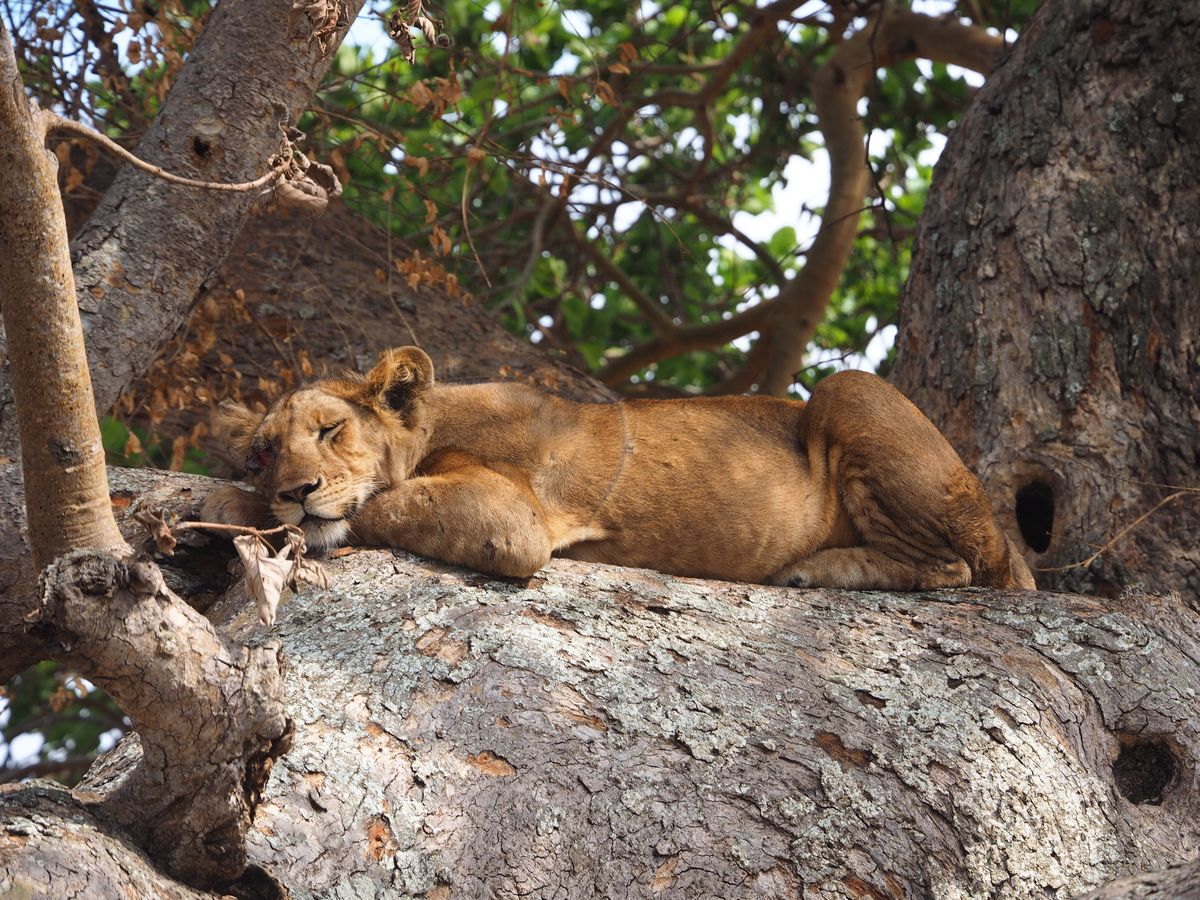
Kibale, in western Uganda, holds the densest chimpanzee population in Africa — tracking them through the forest is loud, disorienting and completely absorbing. A short drive south brings you to Queen Elizabeth National Park, known for its extraordinary biodiversity and, in the Ishasha sector, for lions that climb fig trees.

The Kazinga Channel boat cruise through Queen Elizabeth is a quieter, birder-friendly counterpart to Murchison. Note: the FCDO advises against all but essential travel to parts of the park's southwest sector near Kasese — check the latest advice before booking.

Jinja & the Source of the Nile
04

Jinja & the Source of the Nile

Jinja sits on the northern shore of Lake Victoria, where the Nile begins its journey north. For those who want something physically demanding between park days, this is Uganda's adventure sports base: white-water rafting, kayaking and bungee jumping are all on offer.

It's an easy day trip from Entebbe or a natural stop on the way back from eastern Uganda. The town itself has a relaxed pace and good food — a decent decompression point at the end of a packed safari schedule.

Kidepo Valley National Park
05

Kidepo Valley National Park

Far in the remote northeast, Kidepo is the park you choose when you want to feel like you have East Africa to yourself. Wildlife density is high — lions, cheetahs, ostriches and large elephant herds — and visitor numbers are a fraction of the more accessible parks.

Getting there takes commitment (a flight from Entebbe is the practical option), which is also exactly why the experience is different. If the main Uganda circuit feels crowded in high season, Kidepo is the alternative worth knowing about.

When to travel to Uganda

Uganda has two dry seasons and two wet seasons each year — picking the right window changes the ease of both trekking and game viewing considerably.

June to August
Peak dry season: trails are firmer, game concentrates around water sources and gorilla permits go fast. Book at least six months ahead. Busiest and typically most expensive.
December to February
Second dry season, often overlooked. Conditions for gorilla trekking and savannah safari are nearly as good as the main season, with fewer visitors. Good option if June–August dates don't work.
March to May
First rainy season: heavy downpours make forest trails slippery and some roads impassable without 4WD. Gorilla trekking is harder but possible. Lower lodge rates.
September to November
Second rainy season, shorter and less intense than March–May. Birdwatching can be excellent with migratory species present. Budget-friendlier, but plan for road delays.
Before you travel to Uganda

Before you travel to Uganda

Visa & passport
e-Visa required for UK and US citizens (apply at visas.immigration.go.ug). Passport valid 6+ months, 2 blank pages.
Language
English is the official administrative language and widely spoken. Swahili is also official.
Money
Ugandan Shilling (UGX). US dollars widely accepted, especially outside cities. Carry some cash for remote parks.
Time zone
East Africa Time (EAT), UTC+3. UK: +2h in summer, +3h in winter. US East Coast: +8h (EST). No seasonal change in Uganda.
Plugs & voltage
Type G sockets (same as UK), 240V. US travellers need a plug adaptor and voltage converter.
Health & vaccinations
Yellow fever certificate mandatory for entry. Antimalarial medication strongly recommended. Also advised: hepatitis A/B, typhoid, tetanus, polio.
Getting there
Fly into Entebbe (EBB), 40 km from Kampala. Uganda Airlines now flies direct from London Gatwick.
Getting around
4WD vehicle recommended, especially in the rainy season. Domestic flights (Aerolink Uganda) cut journey times to remote parks significantly.

Common questions about travelling to Uganda

Is Uganda safe to visit right now?
The UK FCDO advises against all but essential travel to parts of western Uganda (including some areas of Queen Elizabeth National Park near Kasese) and Semuliki. The US State Department rates Uganda at Level 3 – Reconsider Travel, citing crime and terrorism. The main tourist parks are operational, but check both FCDO and travel.state.gov for the latest advice before booking.
How many days do I need for Uganda?
Most travellers allow 10 to 14 days to cover Bwindi plus one or two other parks (Kibale, Murchison Falls or Queen Elizabeth) without rushing. A week is possible if you focus on one region — the southwest (gorillas + chimps) or the northwest (Murchison) — but travel times between parks eat into shorter trips.
How do gorilla trekking permits work?
Permits for Bwindi and Mgahinga are issued by the Uganda Wildlife Authority and are strictly limited per gorilla family per day. They sell out months in advance for the dry season. We handle the permit booking as part of planning your trip — let us know your preferred dates as early as possible.
Are there direct flights from London or New York to Entebbe?
Uganda Airlines launched a direct service from London Gatwick to Entebbe in May 2025 — the first direct link between Uganda and the UK in nearly a decade. From the US, all routes involve at least one stop; Ethiopian Airlines, Turkish Airlines and Qatar Airways are among the main carriers, with total journey times around 20 hours.
Do I need a visa if I already have the East African Tourist Visa?
The East African Tourist Visa (USD 100) covers Uganda, Kenya and Rwanda with multiple entries and is valid for 90 days. If you already hold one from Kenya or Rwanda, it covers Uganda too. If you're visiting Uganda alone, the single-entry e-Visa (USD 50) is the simpler and cheaper option.
What vaccinations do I need for Uganda?
The yellow fever certificate is required for entry — have it in paper form on arrival. Antimalarial prophylaxis is strongly recommended throughout Uganda. Additional vaccinations advised include hepatitis A and B, typhoid, tetanus and polio. Talk to a travel health clinic at least 4–6 weeks before departure.
What's the best time of year to see mountain gorillas?
Gorilla trekking runs year-round, but the dry seasons — June to August and December to February — make for firmer trails and more comfortable conditions. June to August is peak season: permits and lodges book out early. December to February is a quieter, often more affordable alternative with similar trekking conditions.

Ready to plan your Uganda trip?

Send us a message on WhatsApp and tell us when you're thinking of going, who's travelling and what matters most — gorillas, chimps, waterfalls or all three.

Step 1 of 4
When and for how long?
Length
Made withsiteway.travel